Spelling in Parts (SIP) Strategy

WHAT IS IT?

Spelling in Parts (SIP) is a strategy that students can use to encode (spell) and decode (sound out) polysyllabic words. The SIP strategy is a variation of the Look, Say, Cover, and Write (LSCW) strategy created by Ernest Horn (as cited in Powell & Aram, 2008, p. 568). The SIP strategy encourages students to listen closely to the word, use common spelling patterns, look for unusual spelling patterns, and divide the words into chunks. When a student is able to do these things, they are employing the three effective strategies all good spellers employ: visual memory, graphophonic knowledge, and morphomeic knowledge (Powell & Aram, 2008).

HOW DOES IT IMPACT STRIVING READERS/WRITERS?

Often times, struggling readers and writers struggle with encoding because they don’t have a strong understanding of sound-symbol relationships. The Spelling in Parts (SIP) strategy “…gives spellers opportunities to discover new spelling patterns for phonemes and helps children who are intimidated by big words to break them into small chunks” (Powell & Aram, 2008, p. 567) According to Powell & Aram (2008), students occasionally neglect saying each syllable in a polysyllabic word, which prevents them from hearing and spelling all of the phonemes correctly.

WHY IS IT IMPORTANT?

As cited in Powell and Aram (2008), “good spellers have a repertoire of spelling strategies, including the use of sound-to-spelling strategies, visualization, and meaning” (Powell & Hornsby 1993; Snowball & Bolton, 1999). Students should possess and be able to use a variety of spelling strategies as they will continue to encounter and be required to use unfamiliar polysyllabic words in the upper grades. Students can learn these strategies both indirectly through reading and writing experiences and directly through direct instruction (Powell & Aram, 2009). Ultimately, when a student is able to chunk words into syllables when spelling, they will be able to transfer this skill to reading, which will benefit their decoding skills, and vice versa.

HOW WILL I TEACH IT?

Objective: Students will be able to use the Spelling in Parts strategy to encode polysyllabic words with vCe syllable patterns.

Engage: Students will use white boards with dry erase markers and erasers during this lesson.

Activity: The teacher will generate a list of polysyllabic words that contain the vCe syllable pattern.

Word List
homemade
milestone
combine
umpire
compensate
illustrate
subscribe
include

Next, the teacher will model the SIP strategy using a few words from the list using the following steps:

  1. Say and clap the word in syllables.
  2. Divide the word into syllables and pronounce each syllable.
  3. Circle the syllables with difficult spelling patterns.
  4. Study the circled syllables and think of a mnemonic or analogy to recall the spelling pattern. (e.g., The mnemonic to-get-her may require the child to divide the word differently to remember the syllables; recall spelling of the first syllable in frighten by associating it with light– I was frightened by the light.)
  5. Cover a syllable, say the syllable, and then write the syllable.
  6. Check and repeat as necessary.

After the teacher has modeled using the SIP strategy to encode a few words, the teacher will provide students with an opportunity to participate in guided practice to use the SIP strategy. When the students are ready, the teacher will use the remaining words on the list and encourage students to participate in independent practice.

Assessment: informal observations; check lists (see below)

HOW WILL I ASSESS IT?

Teachers can assess their students’ knowledge of the SIP strategy in various ways. If the teacher simply wants to know if students can recall the steps of the SIP strategy in chronological order, they could present the student with sentence strips containing each step and ask students to place the sentence strips in chronological order. If the teacher wishes to assess the student’s ability to effectively use the strategy, the teacher can present a list of words to the student and ask them to use the SIP strategy to write each word on the list. The teacher may wish to use a checklist, such as the one provided below, to determine which steps the student is able to perform successfully and which steps may require more practice.

DIFFERENTIATION

In order to differentiate this lesson, teacher can choose different spelling patterns as a focus. In addition, teachers could provide students with different manipulatives to spell the words such as: magnetic letters, letter tiles, wiki sticks, Play-doh, etc. Teachers could also provide students with visual representations of spelling patterns, such as the ones included below, to help students remember the sounds of common spelling patterns.

STATE STANDARDS

Arizona English Language Arts, Grade 5

5.RF.3Know and apply phonics and word analysis skills in decoding multisyllabic words in context and out of context.
a. Use combined knowledge of all letter-sound correspondences to accurately read unfamiliar multisyllabic words.
b. Apply knowledge of the six syllable patterns to read grade level words accurately.
c. Use combined knowledge of morphology to read grade level words accurately. 
d. Know and apply common, grade-appropriate Greek and Latin affixes and roots to accurately read unfamiliar words.
Retrieved from: https://www.azed.gov/standards-practices/k-12standards/english-language-arts-standards/

REFERENCES

Arizona Department of Education. (2020). Arizona English Language Arts Standards. Arizona Department of Education. Retrieved from: https://www.azed.gov/standards-practices/k-12standards/english-language-arts-standards/

Powell, D.A. & Aram, R. (2008). Spelling in parts: A strategy for spelling and decoding polysyllabic words. The Reading Teacher, 61(7), 567-570. https://doi:10.1598/RT.61.7.6
Question-Answer Relationships (QARs)

WHAT IS IT?

The Question-Answer Relationships strategy is an instructional framework developed by Raphael (1982,1986) used to teach striving readers and writers the different types of questions and how to answer them. Raphael suggested that questions could be categorized based on where the answer could be found: in the book or in my head.

In the book questions: right there or think and search. Right there questions are easy to find as they are typically explicitly stated in a single sentence in the text. These questions are often referred to as memory questions, text-explicit questions, literal questions or factual questions. Think and search questions are also in the text, but readers need to look at different parts of the text in order to find the answer (Caldwell & Leslie, 2013).

In my head questions: author and me or on my own. Author and me questions are also referred to as text implicit, inferential or convergent thinking questions. Students must look at what the author has said in combination with their own thinking in order to arrive at an answer to these types of questions. On my own questions must be answered using the reader’s own knowledge or experiences. The answers to these questions cannot be found in the text (Caldwell & Leslie, 2013).

HOW DOES IT IMPACT STRIVING READERS & WRITERS?

Struggling readers and writers often experience difficulty answering questions about a text. This could indicate that they don’t understand the question itself or the text that they just read. According to Caldwell & Leslie (2013), “different question types require different thinking processes to arrive at an appropriate response” (p. 225). Through the use of QARs, students will have a framework to follow that will allow them to begin to think more critically about the type of question being asked and where to find the appropriate answer.

WHY IS IT IMPORTANT?

When a student is able to answer questions about a text, it shows that they understand what they have read. However, if the student is stuck due to a lack of understanding of the question, it will be impossible to gain an understanding of their comprehension as it relates to the text. QARs can also be used to provide a framework for students when generating their own questions about a text. As cited in Duke & Pearson (2009), Yopp (1988) states that “…when students learn to generate questions for text, their overall comprehension improves” (p. 114). When students generate their own questions, they are “…actively constructing knowledge instead of passively receiving it…” (Caldwell & Leslie, 2013, p. 222). In this case, the QAR strategy nicely supports the self-questioning strategy. Overall, when readers are able to ask and answer questions about a text, it will support their comprehension.

HOW WILL I ASSESS IT?

A student’s use of the QAR strategy can be assessed through informal observations or through student work that has been handed in. Teachers can look to see which types of questions students are able to answer or generate successfully versus those they are not. In addition, informal reading inventories often include comprehension questions at the end of the passage that are to be administered to students. Student responses can be assessed to determine which questions students are able to answer. Patterns of error may appear if students predominately provide incorrect answers for either explicit or inferential questions. Teachers can use data collected from these sources to determine if students need additional support with specific question types.

HOW WILL I TEACH IT?

Objective: Students will be able to use the QAR strategy to identify the types of question about a text.

Engage: Students will be introduced to the types of questions and will be provided with a visual representation of each type of question to reference. This may be provided in an individual format, such as a bookmark, or on an anchor chart posted in the classroom.

Below are examples of posters that could be posted in the classroom for student reference when using the QAR strategy. These posters were created by Teachers Pay Teachers author, 3 Little Readers. They can be retrieved from the following link: https://www.teacherspayteachers.com/Product/QAR-Posters-FREEBIE-3299026

Activity: The teacher will present a set cards with pre-written questions about the text Kissing Coyotes by Marcia Vaughan. The teacher will give the student a graphic organizer containing a section for each of the QAR question types, then model placing one question card into each category followed by an explanation for the placement. Next, the teacher and student will work together to sort a few question cards and discuss the reasoning for each placement. Finally, the student will sort the remaining question cards and provide reasons for each placement. The student can request assistance from the teacher as necessary.

Extension: After sorting the cards, the teacher will model answering one question from each category, then guide the student to answer one question from each category. When the student feels comfortable, the student can answer questions from each category independently.

Assessment: The teacher will take anecdotal notes regarding the student’s placement of question cards and the reasoning for each placement. The teacher will also read the student’s responses to the questions answered independently to check for accuracy and validity.

DIFFERENTIATION

The above lesson is designed as an introductory lesson to the QAR strategy and the focus is on identifying the question type and proving understanding of the strategy through explaining the sorting process and product. This lesson can be extended in the same lesson period, or another lesson can be conducted at a later time to return to these questions to generate answers.

Caldwell & Leslie (2013) suggest that teachers begin by introducing and asking students to work with in the book QARs first in order to build confidence. This also enforces the idea that all readers need to reference the book in order to find answers. In addition, Caldwell & Leslie (2013) suggest that teachers begin with shorter passages and move toward longer passages, and start with narrative text before transitioning to expository text as shorter passages are more manageable and narrative texts are typically more familiar to students.

For primary grades, the focus should be on distinguishing between in the book and in my head questions. Starting in second grade, students should be able to differentiate between right there and think and search questions. In intermediate grades and above, they will be able to better differentiate between the four types of questions: right there, think and search, author and me, and on my own. In addition, the use of visual aids and graphic organizers to help students understand the different question types would be beneficial for striving readers and writers as well as English Language Learners (Raphael & Au, 2005).

STATE STANDARDS

Arizona English Language Arts Standards, 5th Grade.

5.RL.1Quote accurately from a text when explaining what the text says explicitly and when drawing inferences from the text.
Retrieved from: https://www.azed.gov/standards-practices/k-12standards/english-language-arts-standards/

REFERENCES

Caldwell, J.S. & Leslie, L. (2013). Intervention strategies to follow informal reading inventory assessment: So what do I do now? (3rd ed.). Pearson.

Department of Education. (2020). Arizona english language arts standards. Department of Education. Retrieved from: https://www.azed.gov/standards-practices/k-12standards/english-language-arts-standards/

Duke, N.K. & Pearson, P.D. (2009). Effective practices for developing reading comprehension. The Journal of Education, 189(1/2), 107-122.

Raphael, T.E. (1982). Question-answering strategies for children. The Reading Teacher, 36, 186-190.

Raphael, T.E. (1986). Teaching question-answer relationships, revisited. The Reading Teacher, 39, 512-522.

Raphael, T.E. & Au, K. (2005). QAR: Enhancing comprehension and test taking across grades and content areas. The Reading Teacher, 59, 206-221.

Word Identification Strategies

WHAT IS IT?

Word recognition strategies are strategies that students use to decode unknown words by looking at word parts. Word recognition strategies are often taught during explicit phonics instruction (Caldwell & Leslie, 2013).

HOW DOES THIS IMPACT STRIVING READERS/WRITERS?

Word recognition strategies help striving readers and writers focus on the internal structure of words. By learning to use word recognition strategies, students can memorize familiar letter patterns within words and use these patterns to decode unknown words (Caldwell & Leslie, 2013).

WHY IS IT IMPORTANT?

Word recognition strategies are important for striving readers and writers, because they encourage students to look within words for clues. Students can look for known word parts such as prefixes, suffixes, roots or other common spelling patterns. When students are able to internalize these strategies, they will develop automatic word recognition skills, thus freeing up additional cognitive space that can be focused on comprehension (Caldwell & Leslie, 2013).

HOW WILL I ASSESS IT?

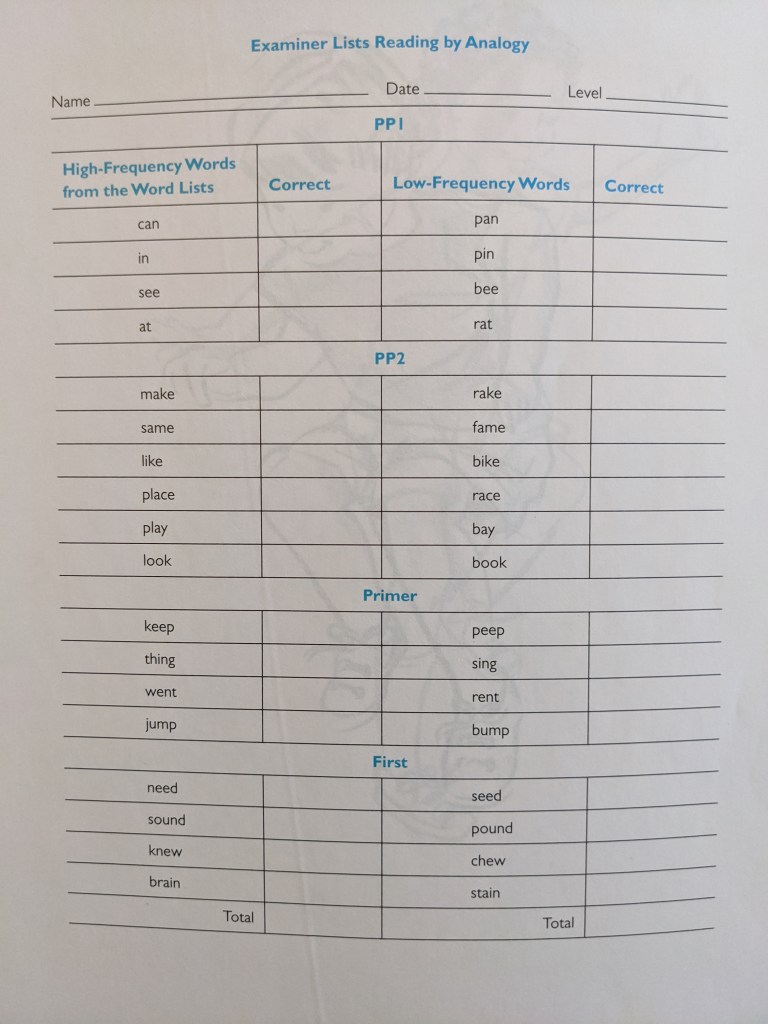
Teachers can assess students’ use of word recognition strategies through informal observations of reading and writing tasks or through the use of reading by analogy. The Qualitative Reading Inventory-6 (QRI-6) by Caldwell & Leslie (2017) provides a word list that teachers can use to assess students’ reading by analogy skills. This assessment helps teachers determine if students recognize familiar vowel spelling patterns within words in order to read similar words. If students are successfully able to read both the high-frequency and low-frequency words with the same vowel pattern on this list, it may indicate that they are paying attention to the internal structure of words as they are able to recognize certain vowel patterns. This may indicate that students have skills in using word recognition strategies that can be further built upon.

The QRI-6 reading by analogy word list has been included below. Teachers can have students read all four levels or just read the words on the portion of the list that matches their reading level. If students are not able to read the high-frequency words at any given level, do not administer the low-frequency words.

Photo of the Reading by Analogy Word List

HOW WILL I TEACH IT?

Objective: Students will sort word cards into categories based on the sounds of the -ed inflected ending.

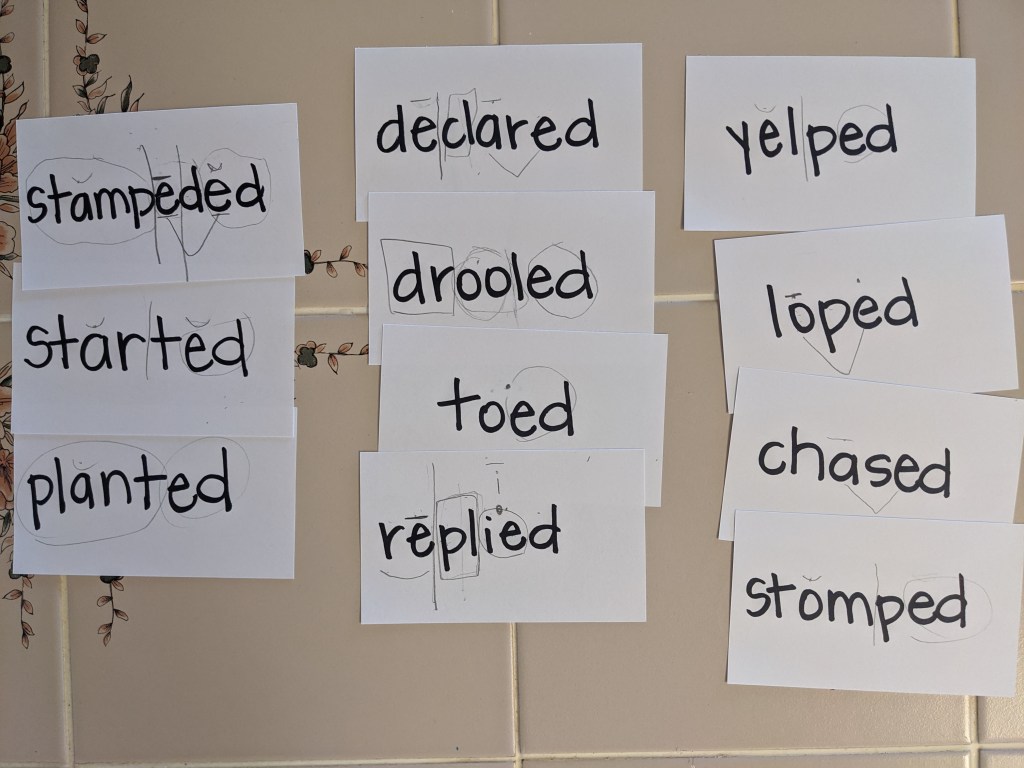
Engagement: Student will decode words that contain each of the sounds of the -ed inflected ending. They will be given a set of word cards and will be asked to complete an open sort of the cards. The teacher will remind students that they are to look for similarities between words when sorting the word cards into three different groups of their choosing.

Activity: The student and the teacher will review how to decode unknown words with the Spot-and-Dot strategy in order to read words with the -ed inflected ending. The student will continue to use this strategy as they read and sort the word cards into three separate categories of their choosing. After the student has sorted the cards, they will reread each word card in each list and explain why the cards have been placed in that pile. The teacher can offer corrections and guidance as needed. The teacher and student should wrap-up the activity by discussing the patterns found within the categories of words.

My tutee, Sam (pseudonym), marked up these word cards during the word sort. He placed them in the columns as shown.

Assessment: The teacher can informally observe the student’s use of the spot-and-dot strategy in order to decode words with the -ed inflected ending. In addition, the teacher can make notes about which words were or were not sorted correctly for review at a later date. This could be turned into a formative assessment as well.

DIFFERENTIATION

This lesson can be differentiated by the number of word cards given to the student, the types of words present on the word cards, or the focus skill of the activity. For example, if a student needed practice with the vowel spellings of the long ‘o’ sound, the word cards could contain words such as “boat,” “row,” or “note.” The student would then need to look at the internal structure of these words rather than listen to the sound in order to sort them into categories. The teacher may also choose to include word cards that are considered outliers and won’t fit into any category. This will force students to again explain why that card doesn’t fit, thus enforcing the spelling pattern or rule they are learning.

STATE STANDARDS

Arizona English Language Arts. Grade 5.

5.RF.3Know and apply phonics and word analysis skills in decoding multisyllabic words in context and out of context.
a. Use combined knowledge of all letter-sound correspondences to accurately read unfamiliar multisyllabic words.
b. Apply knowledge of the six syllable patterns to read grade level words accurately.
c. Use combined knowledge of morphology to read grade level words accurately. 
d. Know and apply common, grade-appropriate Greek and Latin affixes and roots to accurately read unfamiliar words.
Retrieved from: https://www.azed.gov/standards-practices/k-12standards/english-language-arts-standards/

REFERENCES

Arizona Department of Education. (2020). Arizona English Language Arts Standards. Arizona Department of Education. https://www.azed.gov/standards-practices/k-12standards/english-language-arts-standards/

Caldwell, J.S. & Leslie, L. (2013). Intervention strategies to follow informal reading inventory assessment: So what do I do now?. (3rd ed.). Pearson.

Caldwell, J.S. & Leslie, L. (2017). Qualitative reading inventory-6. (6th ed.). Pearson.

Motivation vs. Engagement

In the field of education, motivation and engagement often go hand-in-hand, as they should. Motivation an engagement influence each other, but there is a key difference.

In an oversimplification, I view motivation as intrinsic and engagement as extrinsic. Of course there are instances where motivation can be extrinsic as well, such as when a teacher offers a materialistic reward for completing an assignment. However, in the case of the article written by Afflerbach and Harrison, they determined that “…motivation is a mindset” (2017).

My definition of motivation is this: The intrinsic forces or beliefs that drive a student to perform in a certain manner.

Even in the case of a materialistic reward, as stated above, students will only act if they view that reward as meaningful or valuable. In this case, they are utilizing their own beliefs and values to make this determination, hence the development of a driving intrinsic force. 

On the other hand, engagement seems to be extrinsic. For example, when the environment or activity is intriguing, the student will “tune in.” The student will sort of “perk their ears” and direct their attention in a purposeful way. As teachers, it is important for us to foster an engaging learning environment so that we may draw students in.

My definition of engagement is this: The external factors that drive a student to perform in a certain way.

When a student is interested in the happenings of their environment, they will become more motivated to participate. Afflerbach and Harrison’s comparison of motivation to potential energy and engagement to kinetic energy perfectly illustrates this point. Afflerbach and Harrison state:

Motivation is somewhat like a reader’s potential energy: It is what you have when you are ready to read, when your reading bike is paused, as it were, at the top of a hill. Engagement is more like a reader with kinetic energy: It is manifest when the reader is zooming down the mountain bike trail of a challenging text, fully absorbed, fully engrossed, totally immersed in the activity of reading.

REFERENCES

Afflerbach, P. & Harrison, C. (2017). What is engagement, how is it different from motivation and how can I promote it? Journal of Adolescent & Adult Literacy 62 (2). pp. 217-220.

Striving Readers

WHO ARE STRIVING READERS & WRITERS?

Striving readers and writers are those who experience difficulties with any of the components of reading (eg. comprehension, fluency, vocabulary) or writing (eg. syntax, spelling, etc.). Striving readers and writers may need targeted instruction in order to help them gain confidence when employing the use of various reading strategies.

REFERENCES

Fink, R.P. (2006). Why Jane and John couldn’t read – and how they learned: A new look at informational texts and striving readers 102 striving readers. Newark, DE: International Reading Association.

Guthrie, J.T., & Davis, M.H. (2003). Motivating struggling readers in middle school through an engagement model of classroom practice. Reading and Writing Quarterly, 19, 59-85.

Sentence Combining

WHAT IS IT?

Sentence combining is a strategy that helps students produce and comprehend complex sentences (Saddler, 2007, as cited in Caldwell & Leslie, 2013, p.249). When using the sentence combining strategy, teachers should use deconstructed sentences from texts students read in class. Teachers will use these texts to create kernel sentences, or simple sentences that contain the same content from the original text, but in a less complex structure or format. The teacher then guides the student to use the kernel sentence to construct a single complex sentence.

HOW DOES THIS IMPACT STRIVING READERS & WRITERS?

The sentence combining strategy helps cultivate sentence comprehension as well as increased content knowledge (Caldwell & Leslie, 2013). Through the use of this strategy, students will learn about the different components of a sentence and their purposes. This will not only increase students’ comprehension at the sentence level when reading, but also when writing.

WHY IS IT IMPORTANT?

As striving readers begin to encounter more complex texts in higher grade levels, they will need to read the complex language and sentence structures in those texts. In addition, striving writers will be expected to produce longer pieces of writing, the majority of it being expository. The sentence combining strategy will strengthen their ability to communicate information in writing using complex sentences.

HOW WILL I TEACH IT?

Objective: Students will be able to combine two or three simple sentences into a single complex sentence.

Engage: The student will view the Schoolhouse Rock video about coordinating conjunctions. (https://www.youtube.com/watch?v=RPoBE-E8VOc). The teacher and student will discuss the purpose of coordinating conjunctions and the FANBOYS mnemonic. The student will then write the FANBOYS mnemonic in their journal for later reference.

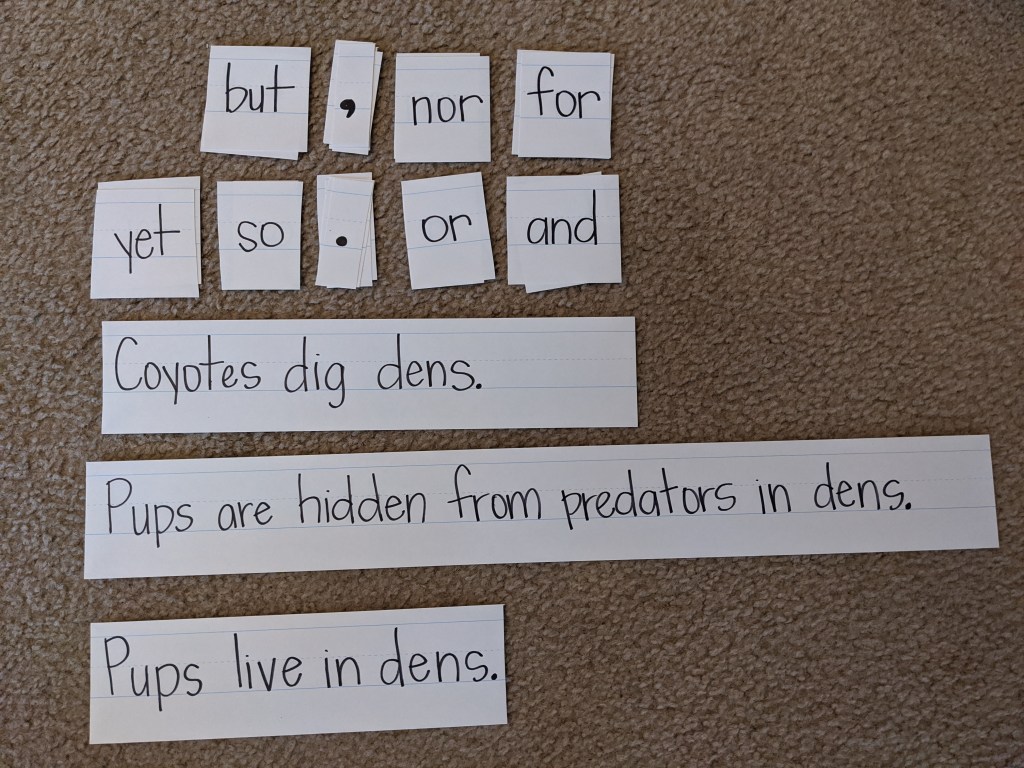
Activity: Student will be provided with sentence strips containing simple sentences and index cards with coordinating conjunctions and punctuation marks. These simple sentences will be deconstructed sentences from the “Coyotes” article previously read. The teacher will begin by modeling how to move the sentence strips and index cards to build complex sentences. Then, the teacher and student will work together to build a complex sentence Finally, the student will be able to manipulate other sentence strips to build additional complex sentences. The teacher will check the student’s work, and the student will copy the sentences they built into their journal.

HOW WILL I ASSESS IT?

I will assess the student’s ability to combine simple sentences to create complex sentences through the use of informal observations. In addition, I could create rubrics to assess the structure of each complex sentence where students could earn points for each part of the sentence they include (i.e. capital letters, punctuation, coordinating conjunctions, etc.)

DIFFERENTIATION

This lesson can be differentiated depending on the skill level of the student. For example, a first grader might be working on building simple sentences using word and punctuation cards, whereas a sixth grader might be expected to use introductory phrases with coordinating and/or subordinate conjunctions. The teacher should consider the student’s background knowledge and current grammar skill set before determining the expectation for the complexity of the finished sentence.

ARIZONA ENGLISH LANGUAGE ARTS STANDARDS, 5th Grade

5.W.2.cLink ideas within and across categories of information using words, phrases, and clauses (e.g., in contrast, especially).
(Arizona Department of Education, 2020)

REFERENCES

Arizona Department of Education. (2020). K-12 Standards Section. Arizona Department of Education. https://www.azed.gov/standards-practices/k-12standards/english-language-arts-standards/

Caldwell, J.S. & Leslie, L. (2013). Intervention strategies to follow informal reading inventory assessment: So what do I do now? (3rd ed.). Pearson.

Disney Educational Productions. (2011, December 8). Schoolhouse Rock: Grammar-Conjunction Junction Music Video. [Video]. YouTube. https://www.youtube.com/watch?v=RPoBE-E8VOc

Comprehension

What is it?

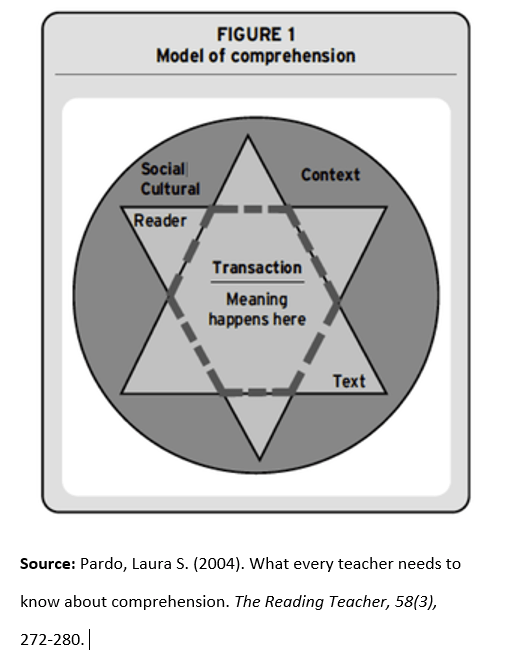
According to the RAND Reading Study Group (2002), comprehension is “the process of simultaneously extracting and constructing meaning through interaction and involvement with written language” (p.11). Comprehension is a complex process that is influenced by the reader and the social cultural context. The graphic below was taken from the article, “What Every Teacher Needs to Know about Comprehension” by Laura S. Pardo.

From a teacher’s perspective, comprehension is the process by which readers use their background knowledge and experiences in combination with information in the text in order to make meaning and develop a stance in relation to the text (Pardo, 2004, p.272).

Why is it important?

Comprehension is important because it involves a student’s interaction with the text and their understanding of the text. Without strong comprehension, students will not be able to understand nor thoughtfully respond to a text orally or in writing. In addition, when students are able to comprehend a text, their worlds will be opened to a plethora of new information that can further expand their knowledge base.

How will I assess it?

I can assess a student’s reading comprehension through informal and formal observations of their utilization of comprehension strategies. In addition, I can use retelling rubrics to assess their listening comprehension of narrative stories.

How will I teach it?

According to Harvey and Goudvis (2013), “comprehension instruction is most effective when students integrate and flexibly use reading and thinking strategies across a wide variety of texts and in the context of a challenging, engaging curriculum.” In addition, it is important to include instruction in a variety of comprehension strategies and also include time for students to read text and respond to the text through writing and discussion.

Objective: Students will be able to self-monitor their comprehension during a read aloud.

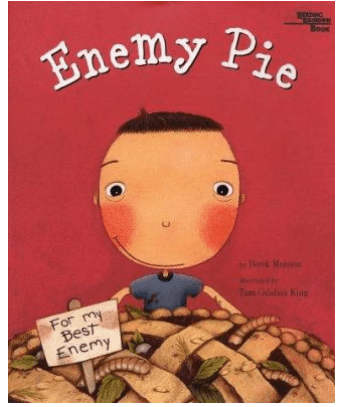
Engage: Read aloud Enemy Pie by Derek Munson; reciprocal teaching

Activity: Teacher will lead students step-by-step to prepare a four-door foldable using a piece of computer paper. Each door will be labeled with one of the components of reciprocal teaching (predict, clarify, question, and summarize). Before the read aloud begins, the teacher will briefly review the four components of reciprocal teaching. (Students will have background knowledge on the reciprocal teaching as well as using the four-door organizer.) The teacher will show students the front cover and students will write a sentence under the “prediction” flap using the sentence stem “I predict…” in order to predict what the book will be about. During reading students will complete the “clarify” and “question” sections. In the “clarify” section, students will write about an idea/ word they don’t understand using the sentence stem “I didn’t get the part where…” or “I don’t understand the word _______.” The teacher will pause at predetermined parts in the book and ask students to write a question they have about the text under the “question” flap. At the end of the book, students will use the five-finger retell method to retell the story to their shoulder partner. The teacher will call on several students to share their summaries of the book. Then, students will be given time to write a brief summary of the book under the “summarize” flap.

Assessment: I would informally assess my students’ ability to effectively use the reciprocal teaching strategy by listening to their partner talk and also reviewing their completed graphic organizers. I could formally assess their listening comprehension by scoring their oral retelling against the narrative retelling rubric. (See rubric attached below.)

Differentiation

There are many ways to differentiate this lesson. In some cases, students may need additional modeling before they are able to take on more responsibility when completing the four-door organizer using the reciprocal teaching strategy. The teacher could also provide more opportunities for students to turn and talk during the read aloud so that students have a chance to chat with a neighbor before they are expected to complete a section of the four-door organizer. Many of my students typically have trouble with retelling a narrative story, so I could also utilize the Goal Structure Mapping strategy to help support students’ understanding of the story elements. We would discuss the story elements and complete the Goal Structure Mapping organizer on the board as a class. When it came time for students to complete the “summarize” flap on the four-door organizer, they could refer to the Goal Structure Map to help them include the necessary information.

ARIZONA ENGLISH LANGUAGE ARTS Standards, Grade 3

RL 3.1Ask and answer questions to demonstrate understanding of a text,
referring explicitly to the text as the basis for the answers
Source: https://www.azed.gov/standards-practices/k-12standards/english-language-arts-standards/

References

Harvey, S. & Goudvis, A. (2013). Comprehension at the core. The Reading Teacher, 66(6), 432-439.

Pardo, L.S. (2004). What every teacher needs to know about comprehension. The Reading Teacher, 58(3), 272-280.

RAND Reading Study Group. (2002). Reading for understanding: Toward and R&D Program in Reading Comprehension. RAND. https://www.rand.org/pubs/monograph_reports/MR1465.html

Fluency

WHAT IS IT?

Fluency includes four components: accuracy, rate, prosody and comprehension. Accuracy is defined as a student’s ability to correctly identify and read the words in a text. Rate considers both automaticity and speed. When a student reads with automaticity, they are able to read the words effortlessly and do not struggle with decoding. A student who can do this, will also read with a higher speed. Prosody is another important component of fluency as it addresses a student’s ability to read with appropriate phrasing and expression (tone, inflection and rhythm) (Deeney, 2010).

WHY IS IT IMPORTANT?

Fluency is important because it connects word recognition with comprehension. When a student is able to read with fluency, more cognitive ability is freed up to focus on making meaning of the text.

HOW WILL I ASSESS IT?

I would assess a student’s fluency using a running record. Using the running record, I would be able to assess a student’s Words Correct Per Minute (WCPM) using the formula below:

(Total # of Words Read Correctly x 60) / Total # of Seconds = Words Correct Per Minute (WCPM)

However, as Deeney suggests, teachers should take a deeper view of fluency. That being said, it is important to assess a student’s reading endurance as well. In order to assess a student’s reading endurance, students should read longer texts that take 4-5 minutes to complete (Deeney, 2010). In addition, it is important to follow-up fluency assessments with comprehension questions about the text as fluency and comprehension are closely intertwined.

HOW WILL I TEACH IT?

Objective: Students will be able to read on-level text with appropriate rate and expression.

Engage: repeated poetry readings and performances

Activity: The teacher will write a poem from the book Read-Aloud Rhymes for the Very Young by Jack Prelutsky on chart paper. The class will engage in several reads of the poem (e.g. whole-group choral, antiphonal choral, or echo reading). The chart will remain posted in the classroom and students will be encouraged to practice it individually and in partners over the course of the week. At the end of the week, students will be given the opportunity to perform the poem for the class.

DIFFERENTIATION

This same activity could be done in small groups and with different levels of texts. In addition, students could use the words from the poem to complete words sorts that focus on various structural features within the words (e.g. rime or number of syllables). Students who are strong readers could write their own poem using new words they brainstorm with the same word family or a different word family. They could then practice and perform their poem for the class.

STANDARDS

Arizona English Language Arts Standards, Grade 1

1.RF4.bRead on-level text orally with accuracy, appropriate rate and expression on successive readings.
Source: https://www.azed.gov/standards-practices/k-12standards/english-language-arts-standards/

REFERENCES

Deeney, T. A. (2010). One-minute fluency measures: Mixed messages in assessment and instruction. The Reading Teacher, 63(6), 440-450.

Rasinski, T., Rupley, W.H., and Nichols, W.D. (2008). Two essential ingredients: Phonics and fluency getting to know each other. The Reading Teacher, 62(3), 257-260.

Phonics

WHAT IS IT?

Phonics is the correlation between phonemes and graphemes in the English language. Phonemes are the smallest units of sound in spoken words and graphemes are the written letters that represent each sound.

WHY IS IT IMPORTANT?

Teachers must explicitly and systematically teach phonics as it helps students understand the alphabetic principle. The alphabetic principle is the understanding that letters represent sounds and are put together to make words. With a strong grasp of phonics, students will be able to use strategies to decode unknown words.

HOW WILL I ASSESS IT?

Teachers can assess students’ phonics knowledge by giving a phonics assessment. One phonics assessment that teachers can use is the CORE Phonics Survey from the book Assessing Reading: Multiple Measures published by the CORE Literacy Library.

The CORE Phonics Survey assesses alphabet skills, letter sounds, reading and decoding skills. This assessment provides both real words and pseudowords , or made-up words, for students to read. Pseudowords are important to include in a phonics assessment because students will be forced to rely on their decoding skills in order to read the word.

Typically, the alphabet skills and letter sounds are assessed in Kindergarten, but they can be assessed in later grades as necessary. First graders are typically assessed on CVC words, consonant blends, digraphs, r-controlled vowels, long vowel spellings, variant vowels, low-frequency vowel and consonant spellings and multisyllabic words. Second and third graders are typically assessed on multisyllabic words, unless otherwise indicated.

It is important to note the following cut-offs in order to determine the type of instruction a student needs in each area of phonics knowledge.

Level of Performance
PartsA-DE-KL
Benchmark83/8314+/1521+/24
Strategic 65-82/8310-13/1515-20/24
Intensive0-64/830-9/150-14/24
Scores are reflected as test items correct / total items.

The materials for the CORE Phonics Survey are included below:

HOW WILL I TEACH IT?

Objective: Students will be able to write single-syllable words with common consonant digraphs.

Materials Needed: Elkonin boxes inside sheet protectors, dry erase markers, erasers, counting chips, digraph sound cards, word list (short, thin, when, phone, chest, shop, lunch, what, thank)

Activity: Review sounds of each consonant digraph with students. Have word list ready. Tell students you are going to say a word slowly stretching it out by sound. The students will repeat the word and count the number of phonemes. Students will then slide one chip into each box for each sound as they repeat the word (ex: thin has three phonemes and will use three boxes, /th/ /i/ /n/). Next, students will slide the chips up and out of the boxes and repeat the process, but they will instead write the letters for each sound using a dry erase marker. Monitor. Repeat the process until students have practiced all the words.

DIFFERENTIATION

I can differentiate this lesson by choosing to use only the chips inside the Elkonin boxes rather than having students also write the letters. In addition, I can differentiate by using the Elkonin boxes to work on other phonics skills.

STATE STANDARDS

Arizona English Language Arts Standards, Grade 1

1.RF.3Know and apply phonics and word analysis skills in decoding one-syllable or two-syllable words. 
a. Know the spelling‐sound correspondences for common consonant digraphs.
b. Decode regularly spelled one-syllable words.
c. Use knowledge that every syllable must have a vowel sound to determine the number of syllables in a printed word.
d. Recognize and apply all six syllable types when decoding grade level texts.
e. Read words with inflectional endings.
f. Recognize and read grade‐appropriate irregularly spelled words. 

Phonological Awareness

WHAT IS IT?

Phonological awareness is a broad topic that addresses a student’s ability to manipulate larger parts of spoken language. These parts include, words, syllables, and onset and rimes. Phonological awareness also addresses the following aspects of sound: rhyming, alliteration, and intonation. Phonological awareness also contains a more focused subcategory called phonemic awareness. Phonemic awareness regards a student’s ability to notice, think about and manipulate individual sounds in words (Armbruster, Lehr & Osborn, 2006).

WHY IS IT IMPORTANT?

Phonological awareness and phonemic awareness is important because they are excellent predictors of children’s success in learning to read. In order to read print, students first need to understand how sounds work within a word. This process begins with providing instruction in phonological awareness, then continues with more focused instruction in phonemic awareness (Armbruster, Lehr & Osborn, 2006).

HOW WILL I ASSESS IT?

I will assess phonological awareness using the Phonological Awareness Skills Test (PAST). This test will assess the following skills:

  • concept of spoken words
  • rhyme recognition & production
  • syllable blending
  • syllable segmentation
  • syllable deletion
  • phoneme isolation
  • phoneme blending & segmentation
  • phoneme deletion of initial & final sounds & initial blends
  • phoneme substitution

HOW WILL I TEACH IT?

Objective: Students will be able to manipulate phonemes by adding phonemes to words in order to make new words.

Materials Needed: uni-fix cubes, word list (flag, flags, flat, flats, plant, plants)

Activity: Have the word list ready. Tell students you are going to say a word, and they are going to segment and blend the word using uni-fix cubes. Each uni-fix cube will be used to represent one sound. Tell students that once they have segmented and blended the word, you will tell them a sound to add to the end of the word. They will then segment and blend the new word using their uni-fix cubes. Model: Sound out “flag” using your uni-fix cubes. Place one finger under each uni-fix cube as you say the sound: /f/-/l/-/a/-/g/. Place your finger at the start of the word and sweep right, blending the sounds, “fffflllllaaaagggg.” Next, tell students you are going to add /s/ to the end of the word to make a new word. Add another uni-fix cube to the end. Place one finger under each uni-fix cube as you say the sound: /f/-/l/-/a/-/g/-/s/. Place your finger at the start of the word and sweep right, blending the sounds, “fffflllllaaaaggggssss.” Tell students that you are going to give them more words to practice with. Monitor. Continue this process until students have practiced all the words.

DIFFERENTIATION

There are often language differences among the students that I teach even if English is their first language. Those who speak in the Navajo Influenced English (NIE) dialect, may have trouble with forming plurals as they often overgeneralize, adding -s or -es endings when they aren’t needed, or leaving them off when they are needed. This may result in students having trouble hearing and processing the -s endings on words.

If this is the case, I would likely spend more time working on articulation with those students. One strategy I would use is to guide students through the process of formulating sounds in their mouths and give students mirrors to watch their mouths as they form and say words with plural endings. For example, changing from the word “plant” to “plants,” I would emphasize how /t/ is formed by placing your tongue behind your teeth and stopping the flow of air. The /s/ is formed with the tongue just behind the teeth, but the air stream must be continuous.

STANDARDS

Arizona English Language Arts Standards, Grade 1

1.RF.2Demonstrate understanding of spoken words, syllables, and sounds (phonemes).
a. Distinguish long from short vowel sounds in spoken single‐syllable words.
b. Orally produce single‐syllable words by blending sounds (phonemes), including consonant blends.
c. Isolate and pronounce initial, medial vowel, and final sounds (phonemes) in spoken single-syllable words.
d. Segment spoken one-syllable words of three to five phonemes into individual phonemes (e.g., /s/p/l/a/t/).                  
e. Orally generate a series of rhyming words using a variety of phonograms (e.g., -ed, -ake, -ant, ain) and consonant blends (e.g., /bl/, /st/, /tr/).
f. Manipulate phonemes (add, substitute, and delete individual phonemes) in words to make new words.  
Retrieved from: https://www.azed.gov/standards-practices/k-12standards/english-language-arts-standards/
Design a site like this with WordPress.com
Get started