WHAT IS IT?
Word recognition strategies are strategies that students use to decode unknown words by looking at word parts. Word recognition strategies are often taught during explicit phonics instruction (Caldwell & Leslie, 2013).
HOW DOES THIS IMPACT STRIVING READERS/WRITERS?
Word recognition strategies help striving readers and writers focus on the internal structure of words. By learning to use word recognition strategies, students can memorize familiar letter patterns within words and use these patterns to decode unknown words (Caldwell & Leslie, 2013).
WHY IS IT IMPORTANT?
Word recognition strategies are important for striving readers and writers, because they encourage students to look within words for clues. Students can look for known word parts such as prefixes, suffixes, roots or other common spelling patterns. When students are able to internalize these strategies, they will develop automatic word recognition skills, thus freeing up additional cognitive space that can be focused on comprehension (Caldwell & Leslie, 2013).
HOW WILL I ASSESS IT?
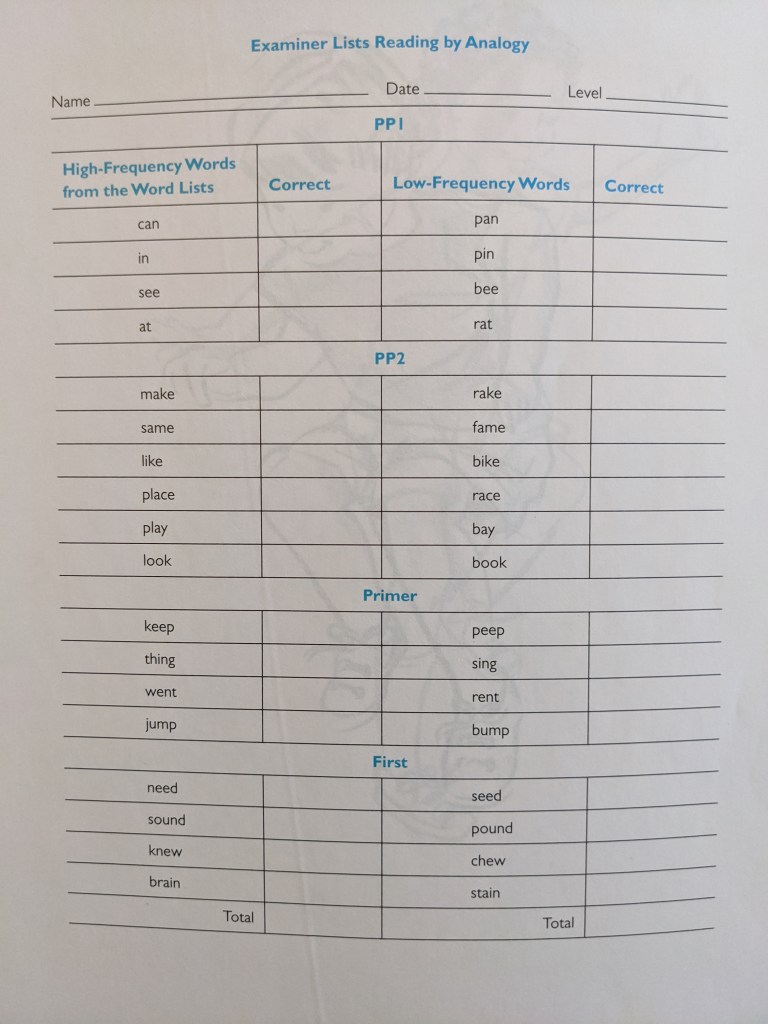
Teachers can assess students’ use of word recognition strategies through informal observations of reading and writing tasks or through the use of reading by analogy. The Qualitative Reading Inventory-6 (QRI-6) by Caldwell & Leslie (2017) provides a word list that teachers can use to assess students’ reading by analogy skills. This assessment helps teachers determine if students recognize familiar vowel spelling patterns within words in order to read similar words. If students are successfully able to read both the high-frequency and low-frequency words with the same vowel pattern on this list, it may indicate that they are paying attention to the internal structure of words as they are able to recognize certain vowel patterns. This may indicate that students have skills in using word recognition strategies that can be further built upon.
The QRI-6 reading by analogy word list has been included below. Teachers can have students read all four levels or just read the words on the portion of the list that matches their reading level. If students are not able to read the high-frequency words at any given level, do not administer the low-frequency words.
HOW WILL I TEACH IT?
Objective: Students will sort word cards into categories based on the sounds of the -ed inflected ending.
Engagement: Student will decode words that contain each of the sounds of the -ed inflected ending. They will be given a set of word cards and will be asked to complete an open sort of the cards. The teacher will remind students that they are to look for similarities between words when sorting the word cards into three different groups of their choosing.
Activity: The student and the teacher will review how to decode unknown words with the Spot-and-Dot strategy in order to read words with the -ed inflected ending. The student will continue to use this strategy as they read and sort the word cards into three separate categories of their choosing. After the student has sorted the cards, they will reread each word card in each list and explain why the cards have been placed in that pile. The teacher can offer corrections and guidance as needed. The teacher and student should wrap-up the activity by discussing the patterns found within the categories of words.
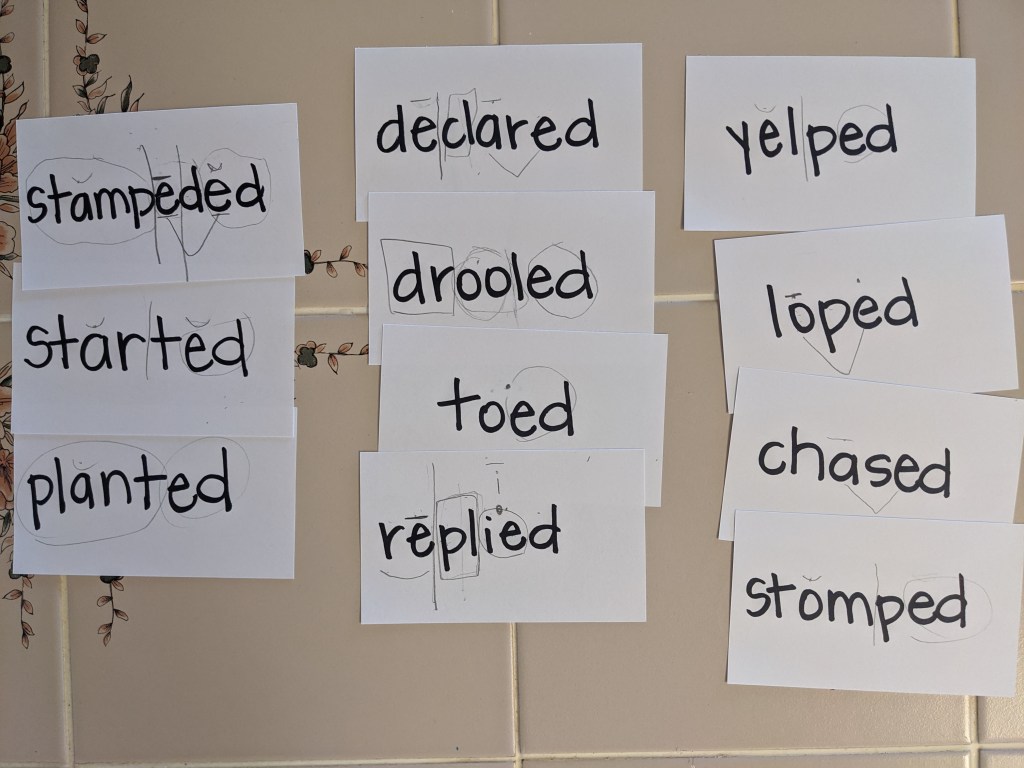
Assessment: The teacher can informally observe the student’s use of the spot-and-dot strategy in order to decode words with the -ed inflected ending. In addition, the teacher can make notes about which words were or were not sorted correctly for review at a later date. This could be turned into a formative assessment as well.
DIFFERENTIATION
This lesson can be differentiated by the number of word cards given to the student, the types of words present on the word cards, or the focus skill of the activity. For example, if a student needed practice with the vowel spellings of the long ‘o’ sound, the word cards could contain words such as “boat,” “row,” or “note.” The student would then need to look at the internal structure of these words rather than listen to the sound in order to sort them into categories. The teacher may also choose to include word cards that are considered outliers and won’t fit into any category. This will force students to again explain why that card doesn’t fit, thus enforcing the spelling pattern or rule they are learning.
STATE STANDARDS
Arizona English Language Arts. Grade 5.
| 5.RF.3 | Know and apply phonics and word analysis skills in decoding multisyllabic words in context and out of context. a. Use combined knowledge of all letter-sound correspondences to accurately read unfamiliar multisyllabic words. b. Apply knowledge of the six syllable patterns to read grade level words accurately. c. Use combined knowledge of morphology to read grade level words accurately. d. Know and apply common, grade-appropriate Greek and Latin affixes and roots to accurately read unfamiliar words. |
REFERENCES
Arizona Department of Education. (2020). Arizona English Language Arts Standards. Arizona Department of Education. https://www.azed.gov/standards-practices/k-12standards/english-language-arts-standards/
Caldwell, J.S. & Leslie, L. (2013). Intervention strategies to follow informal reading inventory assessment: So what do I do now?. (3rd ed.). Pearson.
Caldwell, J.S. & Leslie, L. (2017). Qualitative reading inventory-6. (6th ed.). Pearson.
 Our Literacy Toolbox