What is it?
According to the RAND Reading Study Group (2002), comprehension is “the process of simultaneously extracting and constructing meaning through interaction and involvement with written language” (p.11). Comprehension is a complex process that is influenced by the reader and the social cultural context. The graphic below was taken from the article, “What Every Teacher Needs to Know about Comprehension” by Laura S. Pardo.
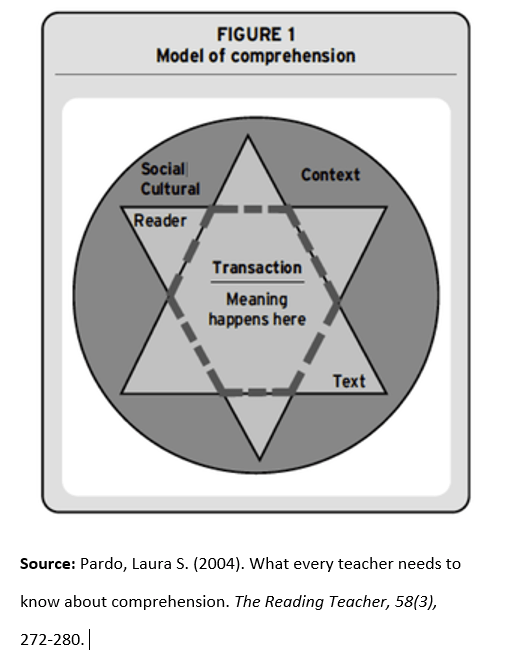
From a teacher’s perspective, comprehension is the process by which readers use their background knowledge and experiences in combination with information in the text in order to make meaning and develop a stance in relation to the text (Pardo, 2004, p.272).
Why is it important?
Comprehension is important because it involves a student’s interaction with the text and their understanding of the text. Without strong comprehension, students will not be able to understand nor thoughtfully respond to a text orally or in writing. In addition, when students are able to comprehend a text, their worlds will be opened to a plethora of new information that can further expand their knowledge base.
How will I assess it?
I can assess a student’s reading comprehension through informal and formal observations of their utilization of comprehension strategies. In addition, I can use retelling rubrics to assess their listening comprehension of narrative stories.
How will I teach it?
According to Harvey and Goudvis (2013), “comprehension instruction is most effective when students integrate and flexibly use reading and thinking strategies across a wide variety of texts and in the context of a challenging, engaging curriculum.” In addition, it is important to include instruction in a variety of comprehension strategies and also include time for students to read text and respond to the text through writing and discussion.
Objective: Students will be able to self-monitor their comprehension during a read aloud.
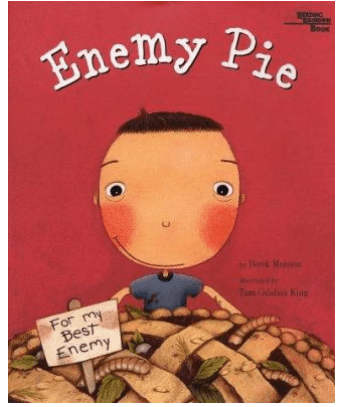
Engage: Read aloud Enemy Pie by Derek Munson; reciprocal teaching
Activity: Teacher will lead students step-by-step to prepare a four-door foldable using a piece of computer paper. Each door will be labeled with one of the components of reciprocal teaching (predict, clarify, question, and summarize). Before the read aloud begins, the teacher will briefly review the four components of reciprocal teaching. (Students will have background knowledge on the reciprocal teaching as well as using the four-door organizer.) The teacher will show students the front cover and students will write a sentence under the “prediction” flap using the sentence stem “I predict…” in order to predict what the book will be about. During reading students will complete the “clarify” and “question” sections. In the “clarify” section, students will write about an idea/ word they don’t understand using the sentence stem “I didn’t get the part where…” or “I don’t understand the word _______.” The teacher will pause at predetermined parts in the book and ask students to write a question they have about the text under the “question” flap. At the end of the book, students will use the five-finger retell method to retell the story to their shoulder partner. The teacher will call on several students to share their summaries of the book. Then, students will be given time to write a brief summary of the book under the “summarize” flap.
Assessment: I would informally assess my students’ ability to effectively use the reciprocal teaching strategy by listening to their partner talk and also reviewing their completed graphic organizers. I could formally assess their listening comprehension by scoring their oral retelling against the narrative retelling rubric. (See rubric attached below.)
Differentiation
There are many ways to differentiate this lesson. In some cases, students may need additional modeling before they are able to take on more responsibility when completing the four-door organizer using the reciprocal teaching strategy. The teacher could also provide more opportunities for students to turn and talk during the read aloud so that students have a chance to chat with a neighbor before they are expected to complete a section of the four-door organizer. Many of my students typically have trouble with retelling a narrative story, so I could also utilize the Goal Structure Mapping strategy to help support students’ understanding of the story elements. We would discuss the story elements and complete the Goal Structure Mapping organizer on the board as a class. When it came time for students to complete the “summarize” flap on the four-door organizer, they could refer to the Goal Structure Map to help them include the necessary information.
ARIZONA ENGLISH LANGUAGE ARTS Standards, Grade 3
| RL 3.1 | Ask and answer questions to demonstrate understanding of a text, referring explicitly to the text as the basis for the answers |
References
Harvey, S. & Goudvis, A. (2013). Comprehension at the core. The Reading Teacher, 66(6), 432-439.
Pardo, L.S. (2004). What every teacher needs to know about comprehension. The Reading Teacher, 58(3), 272-280.
RAND Reading Study Group. (2002). Reading for understanding: Toward and R&D Program in Reading Comprehension. RAND. https://www.rand.org/pubs/monograph_reports/MR1465.html
 Our Literacy Toolbox